Showing posts with label fruit. Show all posts

Sunday, July 04, 2010

Despite the weather


At least we can have summer on our plate. Local fruits, all!

Sunday, June 27, 2010

Sprouted flatbread

Way back in my bread heyday, circa 2005, I made this interesting bread called pitti, from the Hunza Valley in Pakistan (from an Alford and Duguid book, naturally - Flatbread and Flavours). What's so neat about it is that you don't make it from flour but instead from whole sprouted wheatberries; they are almost the only ingredient, with dried apricots and salt. They were really delicious, but I remembered them being a bit of a pain and never made them again.

Looking back with a bit more perspective, I realised that though they do take 2-3 days, there's hardly any work involved (if you have a food processor, that is), and the only thing about them that I had found annoying was having to scrape sticky wheatberries off a dishtowel over and over again while they sprouted. Being the granolaesque West Coasters that we are, in this kitchen we have sprouting trays which would remove that aspect entirely, so I've been meaning to make these since I got back from Asia.

The other day I finally got around to picking up some wheatberries at the local bulk food store and was in business! Wheatberries have nothing to do with berries - they are just whole, dried grains of wheat. You can also soak and then boil them and eat them as a grain, in salads, etc; they are featured in the Ukrainian Christmas dish kutia, mmmm. The cooked grains are also a great breakfast heated and topped with a small spoonful of maple syrup, for a Canadian adaptation.

The first step is to immerse the berries in cold water and let them sit for 18 hours. As easily done as said, except the timing part. For the past weeks I have been unaccountably busy and ended up having to let them soak for more like 22 hours. No big deal. After this, you rinse them off, and then either put them in a bowl and cover them with a towel and plate or lid, or if you have sprouting trays you just pop them in. Every 8-12 hours, you rinse and drain them again, until the sprouts are 1/3 as long as the berries themselves, at which point you're ready to make the dough.

This was a little more problematic for me, as try as I might I couldn't summon up the energy to deal with them after work on Thursday when they were already ready (I expected them to take till Friday). When I did get to them at 11pm on Friday, they had sprouted beautifully and the sprouts were now 2-3 times the length of the berries! Oops! I decided to go ahead and make the dough anyhow.

I did have to deal with one hated dishcloth manoeuvre, pouring the berries out and patting them dry, but once I can handle. Then it was into the Cuisinart, 2 cups at a time, with some dried apricots and salt. You process it until it starts moving around the bowl as one lump of dough. The grains are mostly ground up though some unevenness remains. At that point you need to let the dough rest for at least an hour - or, like me, pop it in the fridge, clean up the sticky mess, and collapse gratefully in bed.

This morning I brought the dough back to room temperature and preheated the oven. Then it was time to divide up the dough and on a floured surface roll out little round flatbreads about 1/4 inch thick. They rest on a baking tray, then bake until firm but still flexible. The result is a dense, chewy bread with soft apricot patches and chewier pockets of grain. When toasted and spread with goat cheese, it makes a fabulous breakfast.

The raw dough smelled sharper and greener for the over-enthusiastic sprouting, but there's not much flavour difference in the baked breads. And they are indeed rather delicious - I might not wait 5 years to make them again this time.

Monday, June 07, 2010

Brunch date: Birthday feast à deux

Last Saturday was Maman's birthday and as it's also her wedding anniversary, we decided to have a special brunch together rather than dinner. I wanted to make it a multicourse feast nonetheless.

The first course consisted of scrambled eggs with fresh cheese, tomatoes, and mint, served with sauteed rainbow swiss chard, and a dollop of the tomato-ginger chutney leftover from the dumpling experiment.

But the real treat was the pain viennois, which I had started at quarter to eight that morning and which baked to a golden sheen just in time for us to eat at 11:30. We had it with fresh rhubarb compote, and a foretaste of the cake to come later that weekend: lemon-chocolate ganache. The bread, while pretty and tasty, was not all I hoped it would be - I think I'll have to go all the way and make brioche next time. But the accompaniments were fabulous - the compote very tart, a soft rich pink that melted into the rich bread. And the ganache was probably the best one I have ever made, so exquisitely bitter with lemon zest that you nearly forgot it was sweet until the chocolate melted on your tongue like honey.

It was a cold grey day, but the table was brightened with vast dark red peonies, and we sat with our coffees dipping baguette points into the little pots and chatting the morning away. Happy birthday Maman!

Monday, March 01, 2010

Planting out the seedlings

I don't know what it's like all over Indonesia, but the fertile equatorial islands of Java and Bali not only host three full harvests a year, but there is no season to the cycle (though rice is best planted in the wet season, and crop rotation is often practiced in the dry season - maybe sweet potato will be grown then, or soy).

So it was that along one small country road in one day, I was able to see all the steps of the cycle - harvest; the mature grains ripening; tall green shoots with no grain yet; delicate small shoots; the planting out of the new seedlings; a bed holding the seedlings in their first days; and ploughing the muddy fields.

It's hard work planting out the new seedlings, which are tied in little bundles and flung into the drowned paddies, then separated and planted painstakingly by hand. It's work mostly done by women, who in old age are often permanently bent, with rounded spines. These women were working cheerfully and energetically in the heat of the day just outside of Yogyakarta in Central Java, stopping to wave and smile as I called out Terima kasih! (Thank you).

There are seasons to other things though, and seasonal beauties just now are avocados, rambutan, salak, sirsak (soursop), and durian. It would be fun to come back when the cloves ripen on the trees - but whatever time of year it's incredibly green here. And full of friendly smiles.

Wednesday, February 03, 2010

Bananas

Also at Talat Siriwattana, Chiang Mai; and a delicious presence everywhere I've been.

Tuesday, December 29, 2009

Strange fruit (vu sua)

One of the many, many delights of exploring Vietnam with Vietnamese people was getting the Fruit Tour of Vietnam. I think I tried ten fruits that were totally new to me, besides luxuriating in some I'd tasted before but never as good as these (though I have to say I think I prefer Hawaiian pineapple.)

Pictured here, vu sua or milk apple (nearly every new fruit I tried in Vietnam was called something apple, except all the ones that grew on some kind of palm).

Everything is edible but the skin and the big black seeds, though the texture changes through the fruit, also depending on ripeness. Some parts were chewy and others soft and jellylike. I found it tasted like a combination of young coconut and lychee, and the opaque milky juice was also delicious.

p.s. Pardon the lack of Viet diacritics - I hate to omit them but it's too complicated to figure out how on a Thai keyboard.

Saturday, December 26, 2009

Longan

While in Vietnam I got the expert fruit tour, and got to try at least 8 new fruits I had never heard of before.

I'd had longan before, but I'd never seen it on the tree, as here in someone's garden in My Tho, in the Mekong Delta.

Monday, November 23, 2009

Mikan

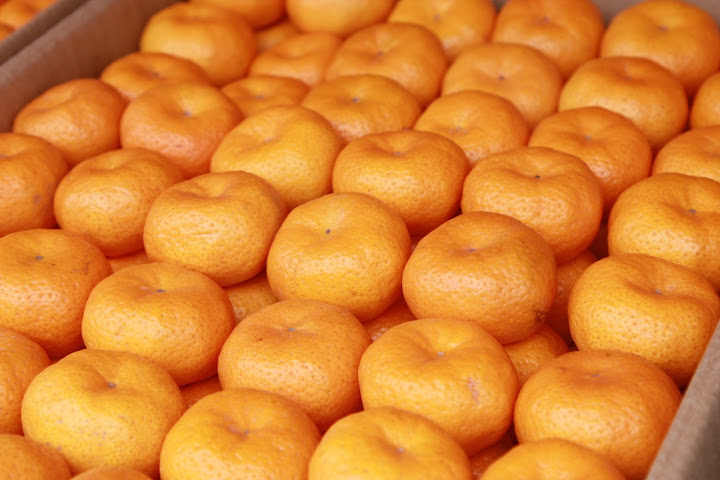
Tiny mikan from the slopes of Sakurajima, the smallest in Japan.