 Burmese meal on the terrace of "our" house, on my last night in Mae Sot, Thailand.
Sunday, March 07, 2010

Sidling sideways
 Past some tiny jewel coloured crabs at a street marketstall on Yaowarat Road, Bangkok Chinatown.
The famous reclining blogger of South-East Asia
Courtesy of my travelling companion in Laos. Homage to the famous Buddha of Wat Pho, with all necessary apologies made...
Giant statue of a reclining blogger, podiatrical perspective, observed on a lazy cafe terrace overlooking the Nam Khan river, complete with reading material, sticky rice meals, and lots of fruit juices, in Luang Prabang.
 Homage to the famous Buddha of Wat Pho, with all necessary apologies made...
Giant statue of a reclining blogger, podiatrical perspective, observed on a lazy cafe terrace overlooking the Nam Khan river, complete with reading material, sticky rice meals, and lots of fruit juices, in Luang Prabang.

Wednesday, March 03, 2010
Banana pancake
 As much as I love local food, there are some pretty tasty foreigner foods around too, like this beautifully caramelised banana pancake with honey, in Yogya.
Remains of Majapahit
 Candi Cetho looms out of the mist, remains of the ancient Hindu kingdom of Majapahit perched at the top of a steep hill in one of the few remaining Hindu towns in Central Java. Most Hindus fled to Bali as Islam spread through Java, but a few people made offerings to a shiva linggam as we walked through the mist.
Monday, March 01, 2010
Planting out the seedlings
 I don't know what it's like all over Indonesia, but the fertile equatorial islands of Java and Bali not only host three full harvests a year, but there is no season to the cycle (though rice is best planted in the wet season, and crop rotation is often practiced in the dry season - maybe sweet potato will be grown then, or soy).
So it was that along one small country road in one day, I was able to see all the steps of the cycle - harvest; the mature grains ripening; tall green shoots with no grain yet; delicate small shoots; the planting out of the new seedlings; a bed holding the seedlings in their first days; and ploughing the muddy fields.
It's hard work planting out the new seedlings, which are tied in little bundles and flung into the drowned paddies, then separated and planted painstakingly by hand. It's work mostly done by women, who in old age are often permanently bent, with rounded spines. These women were working cheerfully and energetically in the heat of the day just outside of Yogyakarta in Central Java, stopping to wave and smile as I called out Terima kasih! (Thank you).
There are seasons to other things though, and seasonal beauties just now are avocados, rambutan, salak, sirsak (soursop), and durian. It would be fun to come back when the cloves ripen on the trees - but whatever time of year it's incredibly green here. And full of friendly smiles.
There are seasons to other things though, and seasonal beauties just now are avocados, rambutan, salak, sirsak (soursop), and durian. It would be fun to come back when the cloves ripen on the trees - but whatever time of year it's incredibly green here. And full of friendly smiles.
Tempeh
 Vegetarian heaven! Crisp freshly fried tempeh with a chile sauce. Too delicious to be properly focussed, apparently, but the textures come through so well that I wanted to post it anyhow.
Gado-gado
 Not the first, not the last, just one of the many delicious gado-gado salads (sometimes written gado2 to my great delight) I've had in Indonesia. Vegetable and spicy peanut sauce heaven...
Nirvana
 After climbing a few sets of steep stone steps, you emerge blinking into the open top level of the temple of Borobudur - Nirvana.
Each of these stupas contains a Buddha statue, many missing parts of themselves after all these centuries but still majestic. The diamond shaped gaps represent the instability of human existence; the square ones, the perfect equilibirum of enlightenment. One stupa's statue is known as the Lucky Buddha, as my guide Aisyah tells me. When terrorists hid 10 bombs in the temple complex, only this one, tucked right into the stupa, failed to explode. She tells me to touch the Buddha and make a wish.
I feel a bit unsure about touching such an ancient monument, but I do anyway. I lean precariously on the rough lip of the stupa and reach my arm through the gap between the interlocking stones, wrap my fingers around the stone thumb, close my eyes and wish.
Monday, February 22, 2010

Banana leaf meal
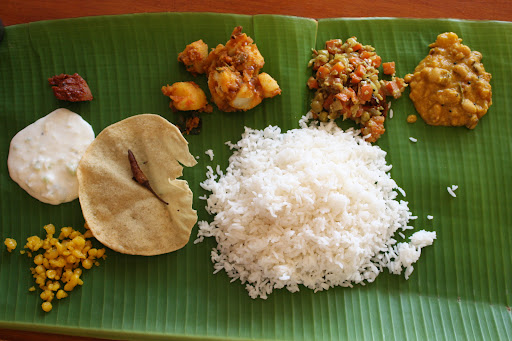 Rice and curry served on a banana leaf in Kuala Lumpur's Little India. Down the block, men were patting nan into the sides of tandoors set right out onto the street, but it had been too long since my last Tamil vegetarian meal!
Right after I ordered a fresh rectangle of banana leaf was placed in front of me, then in swift succession men came by with metal buckets ladling out their ingredients: curd rice, a little sweet, pickle, and appalam; plain boiled rice; potato curry, carrot curry, bean curry; and after I took the picture, three dals ladelled onto the rice - one with whole shallots, one with whole cloves of garlic, and a third liquidy one that blended into the tasty whole.
The waiters kept circling offering more food, and one in particular was playful about it. When I wanted "a little more rice", he gave me about 6 grains, then pulled back his scoop and just looked at me, waggling his head from side to side keeping the smile from his mouth but not from his eyes. Later when I was done, he came up and defiantly put one more sweet, smooth garlic clove into the centre of my leaf as if defying me not to eat it.
Everything was perfectly delicious (and not at all spicy - have I been chile-proofed by Thailand or is South Indian food less hot than it used to be??), so I had to get some laddu to go, too.
Borobudur!
 Hot off the presses from my visit to the Buddhist temple of Borobudur in Java, Indonesia, this morning. It's reputed to be right up there with Angkor Wat (and Bagan, in Burma) - oh, and it is. One of the most beautifully intricate places I've visited, from the moralistic reliefs at the base, through the reliefs telling the jataka tales of Buddha's life, to the simple, beautiful stupas of "Nirvana" at the top level of the temple.

Friday, February 19, 2010
Burmese eggplant salad
 Quite different from Thai grilled eggplant salad, this version is soft and non-spicy, with raw shallot and sesame the major flavours in an otherwise delicate taste.
At Aiya restaurant in Mae Sot.

Early new year morning
 Making offerings at temple in Mae Sot, Thailand. Apparently even though the Burmese New Year is in April like the Thai, Lao, and Cambodian ones, it's popular for many nearby Burmese to come across the border and pray here on Chinese New Year's day.
This early, though, there were only local Chinese families making offerings and setting off firecrackers in the courtyard.
Lahpet thohk
 Burmese pickled tea leaf salad, mixed with fried dried beans and peanuts, cabbage and tomato, sour salty hot and addictive.
Served at Borderline women's craft collective and tea garden, Mae Sot, Thailand.
Dragon-strolling
 Sadly I'm missing the acrobatic dragon dancing scheduled to take place over several floors of my local KL mall tomorrow -- I'm leaving disgustingly early for Java instead. So here's a more humble, laid-back dragon going from restaurant to restaurant in the alleys of Bangkok Chinatown in Feb 14. The city was very very red because besides the Chinese New Year decorations, Thais also go in for Valentine's Day...
Kuala Lumpur is still all vibrant red and gold madness a week after the new year, with lots more going on all over the city. I'd be sorry to leave, except that Yogyakarta beckons...
Fried oysters
 In a back alley off Yaowarat Road, Bangkok Chinatown. Hot panfried oysters on a bed of egg mixed with rice flour cake (noodle texture, but all one piece), with green onion and coriander.
I ordered by pointing, and when I did so before at the same place it came with the oysters mixed into the cake, and with bean sprouts. I don't know the name of either dish but they're both delicious.
Wednesday, February 17, 2010
Happy tigers for everyone
 Murals depicting the Chinese astrological signs in the same Chinese temple in Mae Sot, Thailand.
It's not what you think
 The thing about being in a volatile place like Mae Sot and having read a little too much about drive-by assassinations, is that when you hear what sounds like machine gun-fire in the middle of the night, well, it really could be.
So it was a relief to walk around the next morning, Chinese New Year, and realise that it was actually just strings of red-paper covered firecrackers all along. As an added bonus, I also understood why there were little scraps of red paper everywhere too!
Photo: The courtyard of the Chinese temple in Mae Sot - I don't think its name was written in a script I could read but I think it's the only one, not far from the police station.

Monday, February 08, 2010


Patongkoh
 From China to Malaysia, Vietnam to Burma, these sticks of fried dough are sold for breakfast.
These ones are being made fresh in Laos, and were sold plain (slightly salty) or coated in sugar. They're deep-fried over a fire in a cart, then cooled in a conical woven basket the same shape as a sticky rice steamer before being dispensed to hungry customers.
Later, in Chiang Mai, I breakfasted on the same snack, served with hot sweet soy milk. It's especially delicious dipped right in the hot liquid, if a rather rich way to break a fast.
The dough sticks are yu tiao in Mandarin, and you can buy them in Chinese and Viet groceries all over Canada (though not usually as freshly made). In Laos, they're called pah thawng ko (or so wikipedia tells me) and in Thailand, patongkoh. But pointing and smiling works fine.

River weed
 I just can't get enough river weed. These fresh bundles are being sold at the outdoor morning market in Luang Prabang.
I never managed to try eating the fresh weed while I was in Laos, but I'm told that it's usually stirfried with garlic, and I am confident it's delicious. Next time...
Witnessing
 Photo: Young monk with begging bowl, taking part in the sticky rice ceremony of alms-giving at sunrise, Luang Prabang.
It's curious to go from very touristed places to very undertouristed ones, as your presence means such different things.
In a city like Luang Prabang, which in the past years has seen a huge surge in tourism, which as a small city is awash in the visiting, mostly European foreigners, you are one of a lucrative herd. People aren't surprised to see you. They might be enterprising, they might be weary, they might be genuinely friendly, but they've seen your type before.
When you get further out, even just to the outskirts and sidestreets of the same tourist town, is when you get more of a reaction. People look twice. Sometimes they even look shocked, frightened, as if you've intruded somewhere they thought they were safe - this is a terrible feeling. More often though, people stare openly and with interest, and usually with a generous smile.
It's a whole other feeling entirely in Mae Sot, a smallish town just east of the Thai-Burma border. It's not that foreigners are particularly rare, but most of them are longer-term visitors: volunteers and NGO workers. People's friendliness is stepped up a bit. You're a neighbour, probably even a good neighbour, since you're here for altruistic reasons. So many people say hi, especially kids, and your cheeks ache from smiling back.
The impact that your gaze has is very different too, from Luang Prabang to Mae Sot. Even though I love this photo, I have misgivings about having taken it at all. One of the most popular tourist sights in LP is the early morning alms-giving ceremony. Women get up in the dark to cook sticky rice, make meals, and then dress in their best sihn and blouse, with a temple scarf draped over their shoulders. They kneel in the early morning damp, mist, and chill with woven bamboo baskets in front of them. They wait patiently for the slow approach of the orange-robed monks in single file. The monks will come holding out their begging bowls, and each woman will offer a small ball (which she has pre-rolled) of rice to each monk, each offering a blessing. While the women wait, some chat, while others sit quietly with their faces closed in private meditation. When the monks approach, all the women become still, faces relaxed as they hand out the rice with a prayer, until all the wats have had their turn, and the women can return to their daily work.
It sounds beautiful, and it is. What the photo doesn't show, though, is what a miracle it is that there are no tourists obtruding into the still moment. Even though all over town there are stern documents instructing tourists on how not to ABSOLUTELY DESTROY the alms-giving ceremony, foreigners stand with their enormous cameras right up against the waiting women. The clicks and flashes (because it is still quite dark) rob the moment of its proper solemnity. Though their faces are controlled, it's not hard to imagine how irritating it is to drag yourself out of bed at 4am as a religious duty, a gift, only to have the meaning leached out by the presence of gawky pale people in quick-dry microfibre and fleece. Of course I still went, and I still took pictures, so I am just as guilty (though at a slightly greater distance).
It's the opposite in Mae Sot. There are so many pictures I haven't taken with my camera - but everywhere my eye falls I try to fix the image in my head - faces, artefacts, detention cells. Since being here (where I tend to forget I'm still in Thailand, so Burmese a town it is) I have learned so much more about the situation in Burma, culture and history as well as current deprivation and atrocities. I have met so many open, incredibly generous people, who are so willing to give of themselves, to sit down with me and teach me, even to house and feed me, so that I'll understand.
And on a trip that is largely on the other side, the tourist side of the equation, it's good to be reminded of the impact of witnessing. There is a sense of importance just in knowing, in being able to share stories when across an imaginary line, a border, there is so much armed force commiting crimes of silence, of lies and purges and misinformation. There is a value in seeing, listening, and bringing reality to what was previously abstract.
And there's more of a value when those stories are shared again and again - which I look forward to when I am home.
Friday, February 05, 2010

Wednesday, February 03, 2010


tho-hmwe-t'o-da
 I like knitting. In Burmese.
That this phrase made the Lonely Planet phrasebook almost makes up for my other complaints about it...but not quite.
Photo: Bougainvillea in Bali.
Saturday, January 30, 2010
Sticky rice mountain
 Winter and the dry season and the dead rice in the mountaintop fields.
Luang Prabang province, Laos.
More than that
 Photo: Thatched bamboo house with rice straw roof in a Khmu village, Luang Prabang province, Laos.
I associate the song "Guess How Much I Love You" by the Lucksmiths with being twenty and being in love, and finding any separation at all an ominous, painful gulf. But when I was compiling my travel playlist it felt rather appropriate too.
I bought a postcard
I'm getting close but
I haven't got around to it yet
I know I said I'd write
And maybe I might
It's harႈd to pull together all the threads while travelling, hard to live in the moment and also get to all those things that need doing. Sometimes I feel like all I can think about are obstacles; and things to feel anxious about; and the moments spent waiting for something to happen, as if all the day is nothing but in-between time.
On the map the gap's three fingers
But it's more than that
More than that
Distances can seem so incalculably large when you look at two points, if all you think of is the gulf between them. But travelling this way, roaming over the surface of the earth and finding the familiar in so many previous unknowns, I find myself thinking of it the other way around. It's not gaps any more, but just so much more space to be filled, so much more possibility.
Lyrics.
Friday, January 29, 2010
Found in translation
 Photo: Mekong river weed (khai pen) drying in the sunset on a plastic rice sack, Ban Xangthong, Laos.
I never get tired of coincidental links between languages - they may not have any meaning, but it's enough that they are funny. When I was taking a massage course in Chiang Mai this past week, they were careful to impress upon us the reason why Thai massages might start out too strong for us, and then just get more and more painful.
It turns out that "ow" in Thai means "more"! So the more you exclaim over the pain, the more it will hurt you...
On a related note, aroy means delicious in Thai. There was a saamlaw (motorcycle trailer/sidecar thing) driving around the neighbourhood yesterday with a recording going "aroy aroy!" (I think it was selling ice cream - something tasty anyhow). I was walking with two Filipinos, who burst into laughter. It turns out that "aroy" is the Tagalog equivalent of "ouch!"
Thursday, January 28, 2010

Kaya toast
 The national breakfast of Singapore, minus the sweet milky coffee. Kaya toast is soft white bread toasted, then split right down the middle of the slice. Each bread half is spread thickly with butter and coconut jam (kaya) before being clapped back together. It no doubt gives Singporeans all the energy they need for a busy day of working, shopping, and more eating!

Sunday, January 24, 2010


River weed & satellite dish
 The essentials of life.
River weed from the Mekong is harvested to make the local treat khai pen. Here it's drying, having been spread in thin sheets with sesame seeds, tomato, and garlic. In Ban Xangthong outside of Luang Prabang, Laos.
Saturday, January 23, 2010
Kin khao?
 I spent about four hours uploading photos today, over a slow connection. So my reward is going to be posting a photo of what I had for lunch!
A perfectly seasoned plate of stir-fried local veggies, tofu, and egg over rice. It was made to order and given to me steaming hot, with ice water in a little aluminium cup to refresh me. And it was just the right amount of chile to make my mouth tingle all over with the delicious flavour, without ever overwhelming the other flavours or starting to hurt. Aroy!
Khao niaow
 Sticky rice steams over a charcoal fire in a clay pot. Outside a cafe along the Nam Khan river, Luang Prabang.
O RLY
 I love the knowing look in this chick's eye. Photographed in a Hmong village near Luang Prabang, Laos.
Sihn in Laos
 Please forgive the obscure pun, which I could not resist. Sihn are Lao-style skirts, the local sarong equivalent. They are basically a large tube of fabric with two sets of hooks, attached on the inside at one hip, and on the outside at the other. They are incredibly practical to wear, given that they are loose enough to give total freedom of movement, but keep you covered as wraparound skirts sometimes fail to do. (Apparently lots of styles of sarong are like this too, though I have mostly seen the kind that you just tie around yourself.) And women in Laos - at least the women I saw in Luang Prabang - wear sihn daily. They are the girls' school uniform, and they are worn by market women and women working in travel agencies and cafes and even in the fields and rivers.
Nothing I've said so far, however, reveals the incredible glory of Lao weaving. Even though many of the sihn around are mass-produced machine fabric, the traditional patterns and colours are marvellous. As for the hand-woven textiles, in ikat (locally mat mii) and supplementary weft...well, words fail.
Suffice it to say that I fell in love with sihn (and don't want to mention how many I acquired in my brief time in Laos), but I am not the only one, as this streetsign shows. Apparently the default human who crosses here wears a sihn and her hair in a bun...
Friday, January 22, 2010
Moment of enlightenment
 I read that statues of the reclining Buddha depict him at the moment of his enlightenment. This, the famous reclining Buddha at Wat Pho, is possibly the most beautiful Buddha in all of Thailand - and that is saying something.
When I visited Wat Pho, I was still in that new-to-Thailand state of excitement everytime I saw an orange-robed monk (you do see quite a few of them here, so it wears off a little). So I was especially pleased to see several young monks in their orange robes and their orange shoulder bags, posing in turn for digital camera photos at Buddha's feet! (The surprise wears off at that too, after your thousandth glimpse of a monk on a mobile phone, or of very young boy monks in internet cafes with enormous headphones on.)
As if the giant golden Buddha were not enough, the walls of the temple are also covered in intricate paintings telling legends (jataka? but I thought I saw Ramayana-inspired paintings). And in the wider temple complex there are some beautiful mosaic-covered chedis (stupas), which I didn't see anywhere else.
It's not possible to convey the immensity and loveliness of Wat Pho or of this Buddha in a single photograph - just go, go, go see for yourselves.

Calling the earth to witness
 Buddha is subduing Mara, temptation, illusion, in the old Thai city of Sukhothai.
There are so many distractions while travelling - so much for the senses to take in and discard, so much that is unfamiliar that it overwhelms.
It isn't a bad thing, then, to have so many reminders here of that still point, a way to be alive to the world without being overwhelmed by it.
Not that I'm exactly resisting all earthly temptations, myself...
Subscribe to:
Posts (Atom)