Showing posts with label cooking. Show all posts

Sunday, September 19, 2010

Return by way of an easy weekend lunch

I finally paid a visit to HMart, the Korean supermarket in the middle of downtown Vancouver, last Sunday after a trip to the Central Library. When I'd finally struggled home through the rain, it was to a bowl of cold green noodles in broth, with some steamed shanghai bok choy and stirfried king oyster mushrooms. The day before my first class...

The noodles were tasty, though very chewy, and the broth was a bit sweet but with the fiery chile paste to add in, it was a pretty good instant meal. Especially with dark leafy greens in't.

Sunday, July 04, 2010

Vegetarian Fusion #474

Some days I just cook a lot. Fresh pita, with roasted red pepper puree, and sweet potato-chickpea experimental falafelcakes (made from a puree of the salad pictured earlier) with fresh coriander, and Moroccan carrot salad. It was one of those days where everything tastes exactly perfect, and the only sad part was I didn't finish it all till 11pm and everyone else had gone to bed, so I had no one to share it with. Many more experimental falafelcakes are in the offing - but then, anything tastes good with roasted red pepper puree.

Vegetarian Fusion #473


Or something. Anyway, quick supper inspiration from disparate items languishing in the fridge. A fresh corn tortilla sprinkled with cheddar and then topped with the leftovers of a sweet potato-swiss chard-chick pea salad. After heating it up, I scattered it with chopped farmer's market tomato (so juicy!) and thinly sliced raw red cabbage. Mmm. I didn't make the corn tortilla, alas, but the locally-produced packaged kind are still great to have around. They last for ages and have so much flavour.

Sunday, June 27, 2010

Chronicles of Noodlemaking, Week 10: Sakhoo!

It's been a hard few weeks for the project. Well in fact, for two weeks I didn't even make an attempt to make noodles - noodle apathy! - and furthermore I suddenly got so busy I started to think about giving the whole thing up. I've had fun trying these different noodles, but it didn't seem so pressing anymore to keep going. Then this Saturday worked its habitual cooking magic and suddenly I was trying what's probably the weirdest one so far for the Western palate - sakhoo or Northeast Thai/Issaan-style tapioca dumplings.

Making the dough is very simple and yet was a little nervewracking. All you need to do is boil water, pour a packet of tapioca pearls into a bowl, and stir the water in bit by bit. That's it! But then the recipe (from Alford & Duguid's Hot Sour Salty Sweet) calls for "kneading to a smooth paste". Well. I wasn't sure if the pearls were supposed to dissolve or what, but all that happened was that I turned them out onto the counter and had a therapeutic hand massage pressing down on the pearls, while the liquid gradually thickened and got stickier - not so much of the smooth or the pasty. Eventually I gave up and returned as much as I could to the bowl, letting it rest for the prescribed hour. I figured if it proved impossible to work with I could do something else with the filling.

The filling. The recipe is for sakhoo sai moo, but of course my version would have to be mai moo since I don't eat pork. So, sakhoo sai phak. There were lots of things starting to look a bit sad in the vegetable drawer, so I ended up with a large pot of beet greens, red cabbage, carrot, oyster mushroom, tofu (pressed this time!), and flavoured with onion, garlic, ginger, green onion, fresh chile, rice vinegar and fish sauce. I wasn't entirely happy with the result but it wasn't bad either.

Moment of truth! I returned to the bowl of dough and to my surprise it was a cohesive entity, albeit a frail-ly bonded one of separate little white balls. Still, I was able to turn it out onto an oiled surface, divide it in two, roll it out to a tube and slice it up into 32 rounds. From there, the assembly: each slice is patted out to a disk between oiled palms, then stuffed with a small teaspoon of cooled filling and sealed into a little round ball.

It's a good thing that the recipe urges patience, saying that little cracks will seal up in the pot, because my dough was cracking and falling apart all over the place. I only managed a few dumplings that were fully sealed with no filling on the outside, but somehow each dumpling managed to stick to itself as a little unit.

I lined a steamer tray with cabbage leaves and put the first 8 dumplings into a pot, and hoped for the best. And, miraculously, it all worked! In about 15 minutes, the dumplings turned translucent and though some did fall apart a bit, I was able to pry them all off the cabbage leaves and cook the remaining three batches.

The result was one of the weirdest things I've cooked in some ways, and it was also really yummy. The tapioca was a dense chewy outer layer that set off the strongly flavoured filling very well. Though I didn't actually serve them in any formal sense, just brought one upstairs to be sampled and otherwise ate at the counter while cooking and cleaning up, I did eat them South-East Asian style in method at least. I got some ginger mint from the garden, wrapped each dumpling in a lettuce leaf and sprinkled it with the mint and some nam pla prik, fish sauce with chile. Oh man. I'm a little homesick for South-East Asia right now.

Anyhow, weird and wriggly they may be, but I feel revitalised by sakhoo, and whether I catch up on the three weeks I'm behind on, or just sally on, the project isn't dead yet.

Brunch date: Weekday edition

My theory is it counts as brunch if it's tasty. Quick scrambled eggs with shallot, asparagus, and young pea shoots, toast from my potato-water bread, and the sharp angled shadows of early morning. Best when eaten in a dressing gown.

Chronicles of Noodlemaking, Week 9: More gnocchi

It's not very adventuresome I know, but those first gnocchi were so tasty that I couldn't resist returning to them. There was a large quantity of spinach just starting to go, and my first thought was malfatti which I have yet to try making, but since we had no ricotta and we did have potatoes, regular potato-spinach gnocchi it was.

The method was pretty much the same as the plain potato; you just chop up the washed spinach and mix it into the potatoes around when you mash them. It did make the dough rather moister, so it was a bit trickier to work with, and the end texture a little less perfect, but it was still fun and tasty.

To eat them, I panfried a portion up with nothing more than a little butter, a lot of sage, and a healthy chunk of sheep feta. And it was DIVINE.

Somehow no one else was around and eating, so I worked my way through the whole batch, admittedly getting a little less enthused as the week wore on. But they were also good with salmon and roasted onion and fennel, with herbs and tomato, and just blandly microwaved with parmesan and pepper overtop on a particularly tired day. Mmmm gnocchi.

Chronicles of Noodlemaking, Week 8: Spätzle

It's not that I thought making spätzle would be particularly hard, but I couldn't really believe how little time it took - 20 minutes after I had started whisking the batter together, I was sieving the last little dumplings from their boiling pot. Perfect spätzle doubtless take a lifetime, but I'm here to tell you that delicious, light, chewy egg noodles can be yours in less than half an hour.

I felt like doing something a bit different, and now that my sister's Joy of Cooking has moved back into this house, knew that there would be at least one spätzle recipe there. For a basic spätzle, you stir together flour, baking powder, salt, and nutmeg, then beat in milk and eggs to make a liquidy batter (Joy describes it as "elastic"). Boil a big pot of water or stock, drop little squiggles into the water a few at a time, and rescue them when they float to the surface (which happens quite quickly). Finito! Much easier than pie.

Now for the notes. Making the batter was of course easy, the only difficulty in knowing what the consistency should be. Joy says to taste the first few to make sure they are light and delicate rather than heavy and dense - adding more water or milk is supposed to lighten them. Mine always were quite light but I did end up adding quite a bit more milk (there was the end of a bottle going bad). I used skim for that reason, sort of a compromise between milk and water though usually I'd prefer to cook with 3.25%.

The only real difficulty was shaping the spätzle. It didn't really matter that they were uneven in size, since it's easy to strain each out as it is cooked. It's just that by dropping them from a spoon I ended up with rather distressingly spermatozoidal noodles. I was recounting this to a friend later and she pointed out that I could just push the batter through a slotted spoon - next time!

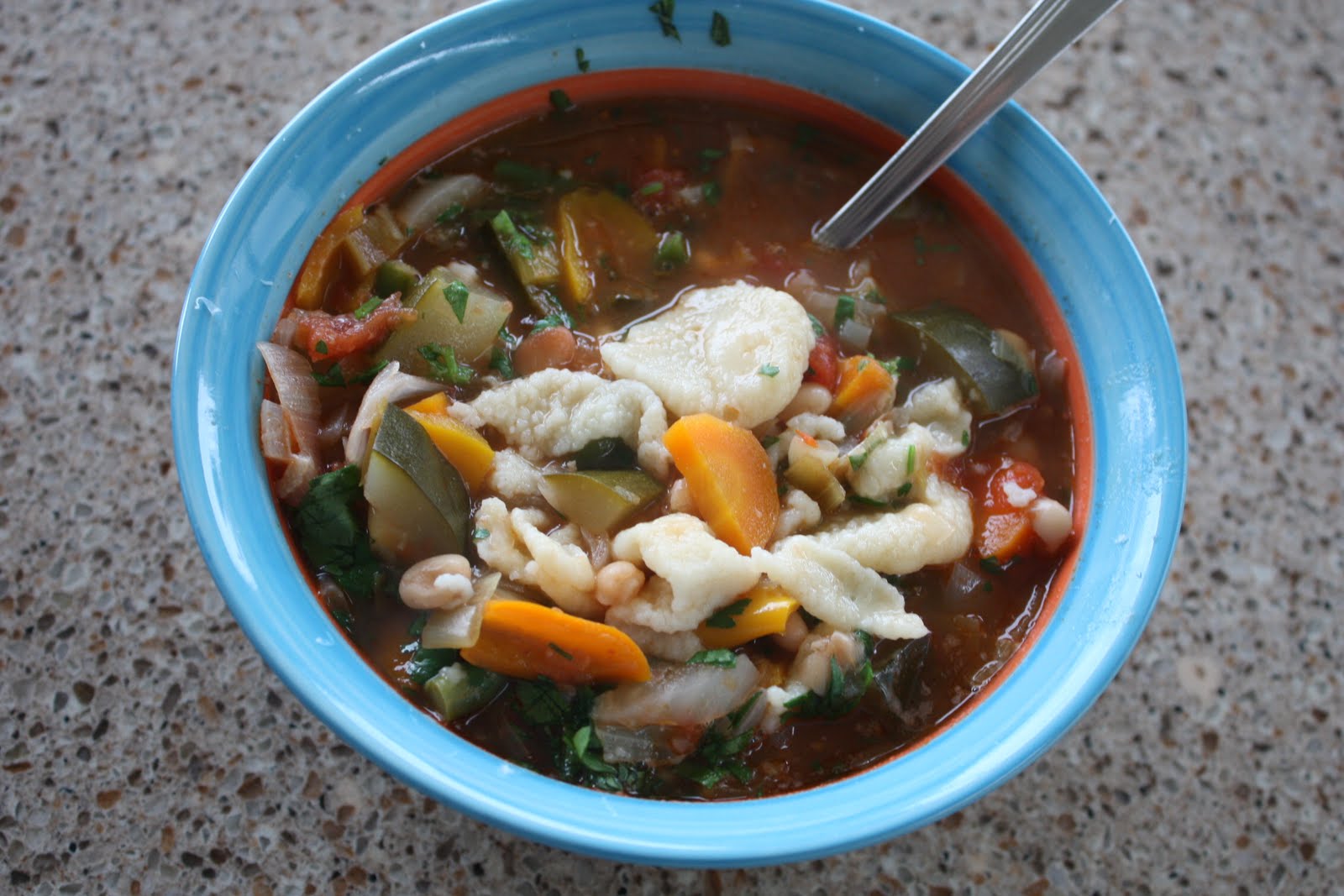
As for eating - well, they were delicious. We have whole nutmegs in the spice drawer, and grating even that small amount in made a huge difference in flavour - it subtly permeated the mouth without being in any way cloying. My mother and I kept snacking on them plain from their platter, but we also ate them in minestrone and they went beautifully there. It is important to not pile them on each other after you fish them out - they don't stick to each other, but they do keep steaming and get a bit soggy that way.

So if you visit this blog hoping for a weeknight noodle, this is the clear winner so far - quick, easy, forgiving and pairing well with lots of dishes. There were quite a few other dumpling recipes in Joy, so I'll have expand my horizons. I don't think I've even tasted U.S. Southern-style cornmeal dumplings - unless they're akin to those amazing dumplings at Jamaican restaurants in Brooklyn? Ah, The Islands, how I miss you and and your okra 'n codfish, and your charming staff that make one not mind that one has to wait two hours for supper.

Monday, June 07, 2010

Chronicles of Noodlemaking, Week 7: Failure!!!

It had to happen sometime. And actually, as failures go, this was fairly unsuccessful, in that it wasn't all that bad. For one thing, I made the failed noodles the same day that I pulled a 16-hour kitchen marathon, so that I was too tired to care whether they tasted good or not, I was just happy to stop making food. And for another reason, they didn't qualify as a kitchen disaster. Disasters, like my attempts to make dosas and injera, have to make a horrible mess that takes hours to clean up, or at least ruins some piece of kitchen equipment. Or at a minimum, they have to use up ingredients too costly to replace. All that happened here was, I made the noodles, and they didn't taste good. Moving on!

The noodle in question was the Hand-Rolled Rice Noodle, and I actually really enjoyed making them. I kneaded together the dough of rice flour, salt and water, before starting the cake layers for my mother's fancy birthday cake. The blob of dough sat resting while I worked my pastry wiles, then I did the shaping and cooking all in the time that the egg whites and sugar syrup for the buttercream were being combined and cooled in the stand mixer. So, another quick and easy recipe.

They were fun to shape, too. With slightly oiled hands, I pinched off pieces of dough, rolled them between my hands into a ball, and then into a tapered cylinder, fat at the centre in the space between my palms and thinner, pointed at the edges. This technique also felt pleasantly intuitive, except that despite repeatedly re-oiling my hands, the dough kept unpleasantly sticking, and didn't seem to be of the right texture. Sure enough, when it came to the boil, I just couldn't cook them to a pleasant texture. It's possible I missed the crucial window, but I think they segued gracelessly from undercooked to overcooked and mushy, with nothing of the spring and bite you'd expect from a rice noodle.

I had made a quick salsa to go with them, Market Stall Fresh Tomato Salsa also from Beyond the Great Wall, which was flavoured with sesame oil and chives and was really delicious. So I mixed my mushy sad little blobs of noodle with the salsa in a bowl and tried to eat them. The flavour wasn't bad, but I had this unpleasant insecurity about whether or not I was eating raw rice somehow, so I eventually gave up. After sampling syrup, curd, ganache, cake batter, buttercream, and meringues all day, it's not like there was much room left for real food anyway.

I have two theories about the failure. One is that right from the get-go I knew the dough was too wet. The instructions explain that it will be stiff and hard to work and mine wasn't - maybe I put too much water in, and if I'd kneaded in more flour as I thought of doing initially, it might all have been ok. The other problem is that I was using schmancy organic brown rice flour from the US rather than standard white rice flour. The former was probably long or medium grain instead of a stickier shorter grain Asian rice, so maybe it was just not great for the recipe. I've now acquired some plain rice flour and I'll be sure to try again...

Saturday, June 05, 2010

Chronicles of Noodlemaking, Week 6: Dumplings!!!

These were amazing. Fun, easy, they came together without a hitch, and most importantly they were delicious. Avanti!

I wanted to make something different, but to begin with they were the same - same as last week that is, since I decided to use the Kazakh noodle dough that I had made the stretched noodles of the previous week. Once the batch was made and resting, I turned to the question of fillings.

The recipe I was working from, Savoury Boiled Dumplings (jiao zi), from Beyond the Great Wall, gave two fillings, both with pork in them. I decided to make two different fillings as well, but vegetarian of course (actually, I put some fish sauce in them, so not really veggie, but oh well). A rummage through the vegetable drawers ended up in a densely flavoured stirfry of onion, garlic, carrot and shiitake. I reserved a bit of this and used it as a flavour base for my second filling, otherwise composed of yu choy and tofu. I made these up as I went along based on memories of my Viet cooking mentor's dumplings, and happily they turned out well, except that in my slapdash cooking ways I didn't bother to press the water out of the tofu before I combined the ingredients. It worked out ok as I was able to just take from the drier bits at the top when assembling, but straining it would have been better as too much liquid in the fillings makes the dumpling wrapper fall apart.

Since the fillings were so easy I also had time to make a tomato-ginger chutney whilst the dough reposed - a Tibetan recipe from the same cookbook. It was tart, gingery, intense, and redoubled my enthusiasm for expanding my sauce repertoire. Mmm.

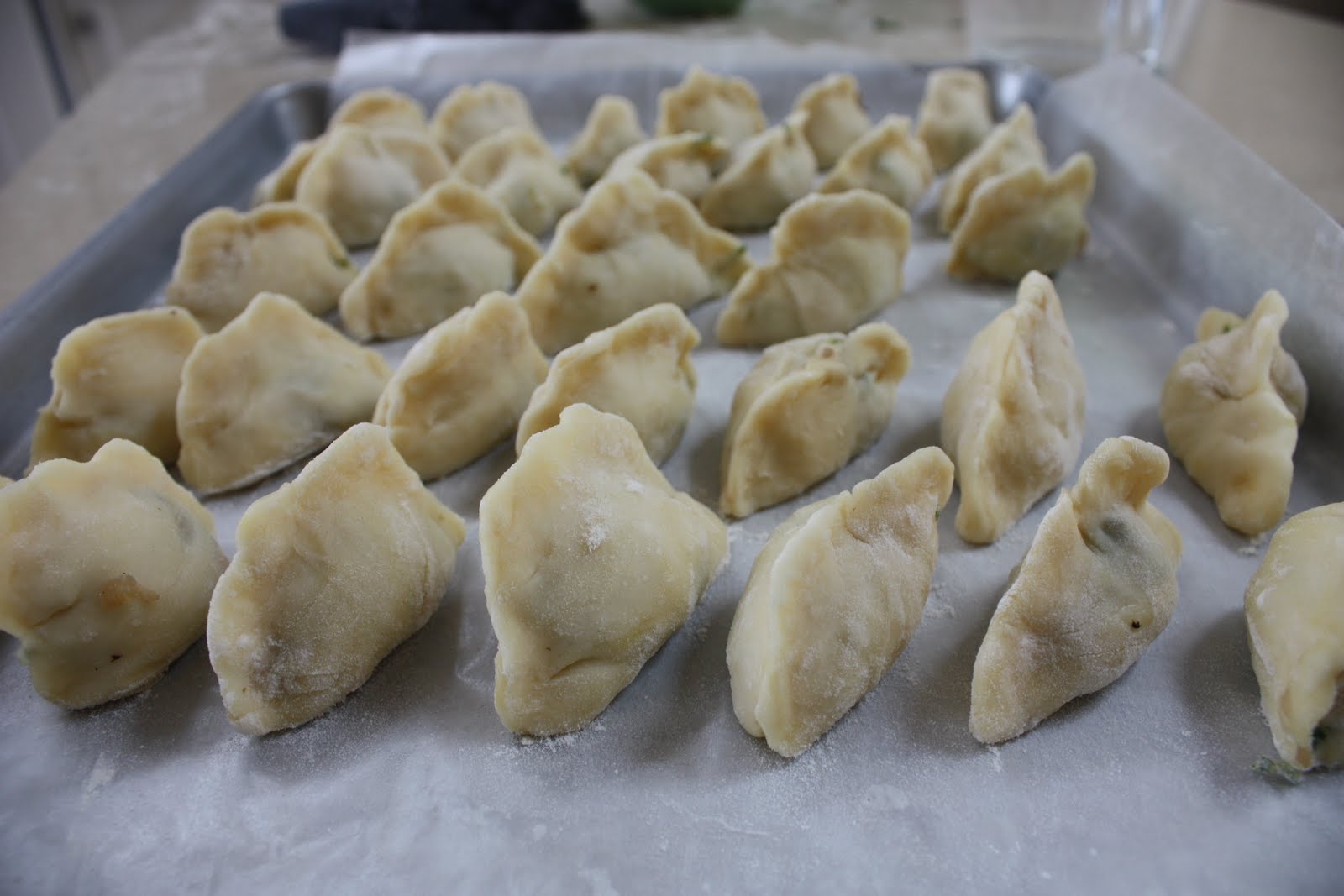
It was time to shape! After putting on a pot of water to come to the boil, I divided the dough in 8 pieces, and then each piece in 8 again, for 64 dumplings. It was so quick and pleasant putting them together that I could easily imagine a marathon dumpling-making session, especially sitting with a couple of friends chatting and drinking tea. If the idea appeals, just let me know...

There was no need for a rolling pin - I tried patting and stretching the dough and both worked. It stretches easily, but much more so in one direction, as cutting it severs the gluten strands that give it elasticity. So patting it out allows you to shape the piece more regularly, but stretching is faster. The results were about the same in the end - a piece more rectangular than round, but easy enough to fold into a half-moon shape, with dappled pinched edges.

The dumpling wrappers were much thicker than the commercial ones I'd used before, but they were actually easier to work with - they sealed better, didn't stick to the surface as long as I kept it floured and worked swiftly. Even my liquidy filling problems were solved by patting in a bit of extra flour to persuade the dough that it didn't want to give into structural anarchy. It wasn't long until I had shapely little rows lined up for the boiling.

I had been a bit apprehensive about the cooking, since I know dumplings are prone to falling apart, and the recipe called for boiling, not steaming. But I prefer to follow directions at least the first time through, so I tossed the first 8 into the salted rolling waters and hoped for the best. And - perfection! None of them collapsed, and though the cooking times, dumpling sizes, and dough thickness, were all slightly uneven, each dumpling had chewy bite without being either hard or soggy. They were seriously good. My only cooking complaint is that I hadn't fully precooked the yu choy, and I think it would have been better that way - the fillings were heated through, but they're not cooked for long enough to work any chemistry on the innards.

I decided to only cook half, freezing the other 32 (my nefarious plans for them include dumpling noodle soup, something I love but can never find vegetarian versions of in restaurants). Soon they were in two bowls, divided by filling type, and I was calling my mother up for a taste test.

I had put out three dipping sauces to accompany them - the tomato-ginger chutney, and then two simple traditional accompaniments. One was just soy sauce and sesame oil; the other was just fish sauce with sliced thai bird chiles. We dipped and sampled all six combinations, and then just kept eating. The verdict was unanimous - the shiitake-carrot filling was the tastiest, having much stronger flavour, but the tofu-yu choy went better with the intense taste of the chutney. The chutney was probably the overall winner, as everyone who passed through the kitchen that day found excuses to help themselves to spoonfuls of it on its own. I think my favourite pairing was the fish sauce-chile one, though. It's funny to remember my initial reservations about fermented fish condiments as contrasted to my love for them now. They add so much more than a salty flavour, especially when paired with chile.

I was amazed by the texture of the dumpling wrapper. Even though it had just been boiled for a minute, it was much more like a steamed bread, very light. In the photo if you look closely you can see little air bubbles in the dough, especially at the pleated top. Thickness didn't at all equate to heaviness.

These were so much fun to make, and not that much work, especially if you had a leftover sauce or stirfry you could recycle as a filling. Most importantly they were also a lot of fun to eat. They were out on the table with their sauces and before I knew it they were all gone. I found an interesting recipe for tapioca dough dumplings, so that might be my next dumpling foray. Miam!

Friday, June 04, 2010

Brunch date: Fiddlehead Frittata

I love brunch. I love going out for brunch (preferably on weekdays; ah for my beloved Plateau lifestyle); and I love making it at home. For years and years I have kept going on about how I want to have regular brunch parties, since the food is so tasty and it's such a cosy relaxed meal to share with people. But in practice, life is busy and it never gets around to happening.

So, I've decided to take action by inaugurating the Stealth Brunch Party. For the last three weeks, I've made something fancy and/or exciting for brunch on Saturday mornings. It started with Mother's Day, continued when fiddleheads (my preferred augur of spring!) showed up at Granville Island market (albeit for a hairraising $10/lb), and then Maman's birthday was a further excuse. Sure enough, whether we all sat down together or people just helped themselves as they passed through the kitchen, everyone in the house eventually partook. I figure if I'm consistent enough, my brunch parties will become a reality.

So now you know - if you're in Vancouver of a Saturday, drop on by. Otherwise you can feast visually, as I plan to post photos on the blog. The idea is that the tradition marks some intersection of the practical (using up leftovers, in the way that cooked salmon from the previous night's dinner wound up in this dish) and the creative (not just brunch but original brunch is what we strive for!). We'll see how it goes, but so far, it goes tastily.

Monday, May 17, 2010

Breadmaking update: Brick ovens, kabocha, and very unscientific levain!

It might be the fact that I have absolutely no breadmaking agenda these days, but for whatever reason I have been baking pretty much nonstop. So much that I forgot to write down whatever I did to produce the rather awesome experimental espresso-spelt bread, though hopefully I'll be able to more or less reproduce it. Yesterday I actually had a reason to bake though - we were firing up the brick oven again, and wanted to have some loaves to show for it.

I stirred together a regular spelt poolish the night before, and planned to put the leftover roasted squash from that morning's waffles to use in it in some way. It was only Sunday morning that I remember the little lump of dough languishing in the fridge hoping to become my first attempt at the levain method someday. So I decided to go for two separate doughs, figuring that the levain might be a total failure, but even if it succeeded, the 14 people attending that night's dinner would probably be able to keep up with the eating.

Of course, I only thought about the levain when I got home from yoga at about 12:30. After a quick perusal of our cookbooks and some online sources, it was pretty clear that I wasn't going to be able even to approach orthodox levain methods since at the very latest I should have started to reactivate it the night before. Instead, I just decided to take what I vaguely remembered having read about levain some years before, and just run with it. What could happen?

It wouldn't have been your purist's levain in the best of timings. Levain is a wild-yeast method akin to sourdough. The classic French countryside technique, it involves keeping back some of the preceding week's batch of dough to start the next. Originally it would of course have been kept at room temperature, there not being any other temperature. All that fermentation gives you plenty to work with, keeps the wild yeasts alive in your kitchen. What appeals to me about levain over sourdough is that you don't have to keep refreshing the starter in a way that has always seemed rather wasteful to me (I should state upfront that I have never made proper sourdough yet, though I will get around to it eventually). Instead, you just take your preserved lump of dough, now incredibly stringy with gluten and very wet from all the reactions that have gone on during its resting time, and combine it fully into the new dough. Then before baking, you keep back a new piece, child of the current batch, for use next week.

That much I remember from my prior reading. Anyhow, now I was faced with a cold, stringy little lump of dough, which itself had been started with yeast, albeit slow-started with only a 1/4 teaspoon and left to itself to develop into a fully-raised dough. Nothing purist here, but in for a penny. I decided to help myself out a little, and make this dough in the same bowl I'd had the poolish for the squash dough in, so that the levain could get a little boost from the recent yeast activity still clinging to the sides of the unwashed bowl. I poured in a little water, and started to break up the levain in it with my fingers.

I had to start giggling for a bit, as it seemed like rather than levain, I was ending up with something else I had read about but never made - seitan (wheat gluten, the stuff Asian fake meat is often made of). You make it by developing strands of gluten and gradually washing the starch out of it till you're just left with pure strands of gluten. And that's what I had - stretchy strings of gluten that wouldn't dissolve but kept recoalescing in the water under my fingers. At least they were resilient!

After awhile it seemed I'd done all I could do, so I started stirring all purpose flour into the bowl, and made a little sponge that I left to activate for a bit, just to see whether anything was really going to happen at all in the midst of all this unorthodoxy.

While it was resting I made the dough for the squash bread. I mashed roasted kabocha squash into some yogourt, then stirred in the poolish and a bit more water, then some rye flour. All things considered, I would have liked to have given that sponge a few hours to get acquainted with itself, but instead I just gave it a few minutes and then stirred in all purpose flour until it was ready to be kneaded. After being dubious at first, I have become a total convert to Richard Bertinet's kneading method, described in detail in his book DOUGH: Simple Contemporary Bread. It's got great recipes and the design is lovely, but the best part is this method totally unlike any other I've seen described. The crucial parts are, don't flour the work surface, and rather than pressing and folding the dough over itself, you pull it away and toss it forward, so that you are always stretching the dough and encouraging its growth. There are moments where the dough seems impossibly sticky, but it has always come together for me in the end. I am sure I have been saved from many otherwise unforgivable bread mistakes by the way this knead builds cohesion and resilience in the dough.

Back to the levain, and to Bertinet's kneading again. The bubbles in the sponge showed that SOMETHING was working, and the kneading transformed my little brown blob into something that was clearly leavened bread dough. The gluten strands were short with a tendency to break at first, and the dough was definitely a bit stiffer than what I usually produce, but by the end of the kneading it was a creditable effort. Just a couple of hours to rise, and my lunchbreak.

By this time the fire was roaring, and the dough was ready for shaping. My squash dough became three loaves and 8 pizzette, the levain one loaf, 7 pizzette, and one little lump of dough back in the fridge to wait for next week's levain experiment. A la le Fromentier, beloved Montreal bakery, the squash dough was adorned with black sesame seeds, and one of the loaves got studded with pumpkin seeds. The levain stayed plain, and all the loaves were hidden under double layers of kitchen towel to rise.

Maman had requested pizzette to go along with the olives and other antipasti when everyone arrived, and overall I prefer pizza bianca so that's what we had. I plucked a handful of nearly everything in the herb garden (rosemary, thyme, sage, tarragon, oregano - I left out the lavender; and some basil), chopped them and stirred them into olive oil, then rubbed the tops of the rolled out rounds of flatbread that had already risen for 30 minutes. I had intended to serve them with feta, but it had gone off, so it was just veggies. Some I made with cherry tomato halves, others with the rest of the roasted kabocha, and some with both.

We've lit the brick oven a few times, and I have made dough for it before but not actually presided over the baking. It was slightly stressful but also really fun, spinning the disks of dough about right next to the burning logs so as to brown them evenly, learning the best in-the-absence-of-a-peel technique, and leaping madly on the errant tomato halves that tried to bake solo. A few more sessions and I think I'll have it down.

I was a bit less successful with the loaves - I only managed to bake one in there around the roast pork, huge trays of roasted vegetables, whole kabocha squashes (for an amazing goat cheese, arugula and mint warm salad) and the tray of baked pears for dessert (served with the now-legendary homemade honey-thyme ice cream). That one loaf ended up with a carbonised exterior that I had to peel off. The bread inside was quite delicious though - moist, airy, well-structured, a lovely tan colour shot through with bright orange from the squash. We passed it around picking off pieces and the whole thing vanished before supper was properly begun. I baked the other three in the conventional oven, by which time they were a little overrisen and not at their best. The crust is more hard than crisp, but the dough structure in the levain is fantastic - well aerated and spongy. The taste is subtle but good - I'll have to see if later experiments can yield a more sourdoughy flavour. The squash bread is softer and a little sweeter and cries out to be made into a grilled sandwich.

All in all a good day's breadmaking - and with 14 of our extended family sitting down together outside in the obliging evening sunshine, with the wild gymnastic displays by my boy-cousins, my nieces' kindness in sharing their dinner with my recycled My Little Ponies and the poor, pork-smeared stuffed emu; with reading some books in the glider before dessert, and fighting my toddler niece for control of our shared dessert spoon (and saving the emu from chocolatey smears to match the pork ones) - a perfect Sunday evening.

No noodles this week

Too busy baking bread.

I'll try to make up the noodles by doing two in one week sometime soon. Technically, I did cook the dried Kazakh noodles last week, but that just sounds like an excuse. I may double up by making dumplings and noodles in the same week, just to mix it up a bit.

Bread post to follow!

Wednesday, May 12, 2010

Chronicles of Noodlemaking, Week 5: Hand-stretched Kazakh Noodles

The Kazakh noodles, from a recipe in Beyond the Great Wall, were a departure. While the preceding four types were shaped in different ways, they were all quickly cut or torn into small rounds or squares or spheres. These long noodles had each to be stretched by hand into skinny strips, which made them a bit more time-consuming. In the end though, they were still easy and fun - and delicious.

The dough was similar to the other Asian noodles I've made so far - eggs, flour, salt and water mixed into a stiff dough and briefly kneaded. Rather than letting the dough rest in a ball before shaping, though, you divide it in four and pat each quarter out into a rectangle, and then cut it crosswise into strips (the dough scraper is very efficient for this) before covering it and letting it rest. Here's where I made my slight mistake - I rolled the quarters out instead of patting them, since the dough was quite stiff and resistant to being flattened. Although I'd read the directions through already, if I'd really pictured the process I wouldn't have done this, since it's not important how big the strips are, and I think it contributed to the problem I had of the dough drying up and thus not stretching as evenly. If you're going to let the dough sit a bit longer or you are doing all the shaping yourself, as I was, I recommend really covering it up well, with a couple of cloths (at least one of them dampened), as the dough's not as fun to work with when it starts drying out.

After the rest period, the fun begins. You just pick up each strip, and using one hand stable and pulling against it with the other, kind of like drafting for spinning, you stretch and flatten your little strip into a veritable noodle, long, thin, glorious-looking. This step was very exciting for me. As long as the dough wasn't dried out, its egg-rich strength made for a beautiful even stretch, and elegant noodles up to 40cm long. Unable to come up with an equally elegant drying rack arrangment, I just draped them over cooling racks and a couple of floured cookie sheets for their resting time. This worked fine, but someday when I'm making a big batch I think I'll clean the clothes-drying rack and use that - I love the image of long rows of noodles swaying gently in the breeze!

In a rash of enthusiasm, I turned last Saturday into a cooking frenzy, and along with these noodles I made rice and beans and vegetables, and fresh tortillas, for supper; dairy-free chocolate banana cake for our lactose intolerant friend; and some bread and pita just because. So I only ended up cooking up a small portion of the noodles for myself while they were fresh, before we dispersed to our various yoga classes and then came back to eat the Mexican food, drink wine, and watch Buffy.

Having the fondest memories of the exquisite hand-stretched northern Chinese noodles you can get at the Richmond Public Market foodcourt (pictured on the blog sometime in 2008), with their tomato-egg sauce, I made a quick but loving tribute to the more elaborate dish. Just stirfried some cherry tomatoes with lots of ginger and green onion, scrambled an egg into it, cracked some pepper over top, all in the time it took to boil my nice long noodles. Mmmm...the noodles were delicate and soft but not soggy, long enough to be comfortably slurpable, both easy to swallow yet still with that nice fresh-noodle bite to them. And tomato-ginger-green onion must be one of the great all-time flavour combinations...

The recipe also allowed for drying the noodles for a few days before cooking them, so that's what I did with the rest of them. If you see a pinkish tinge to the noodles in the photo, it's because I used swiss chard cooking water in the dough. It disappeared when they were cooked again but showed up well in the dried format - if it affected the flavour at all, it was too subtle for my palate to notice. After leaving them in an artistically random pile on the counter for a few days, I boiled them up and tossed them with another quick stirfry, this time with shallots and garlic and yu choy alongside the tomatoes and ginger and spring onion, but no egg (I don't know why I didn't put tofu in - next time). The texture wasn't quite as stellar for the dried version, but that was probably just me getting the cooking time wrong. Still delicious - especially because I had them for breakfast.

These noodles were awesome. I can't wait to make them again.

Tuesday, May 04, 2010

Chronicles of Noodlemaking, Week 4: Lhasa Egg Noodle Shells

After the gnocchi interlude, it was back to Tibet and the third in the small-Tibetan-wheat-noodles category from Beyond the Great Wall. The last of these similar recipes is also handshaped, and has an egg in the dough like the Earlobe Noodles, but no oil. I made the dough, let it rest, then cut it in pieces, rolled it into logs, and divided those into smaller pieces, just like shaping the gnocchi last week. From here, you take each little piece and use your thumb to flatten it against your palm, so that you end up with a pretty little shell, thicker at the edges and quite thin in the middle (actually I thought these ones looked a lot like earlobes).

I don't know whether I made these larger than I was supposed to, but they seemed to take awhile to cook. Tasting the half-cooked ones made me a bit worried as they seemed bland and tough, so I decided to pan fry them to give them a bit more flavour. Butter, the rest of the caramelised onions, and more fresh herbs, plus a bit of crisping from the heat, and they turned out to be pretty yummy after all.

It was family Sunday dinner again, this time with my uncle, aunt, and two boy-cousins, as well as the home group of Mom, Grandma, and both my sisters. We had a huge meal that came together casually with everyone making a few things - the best kind. My uncle, the chef, had brought an enormous halibut, and after making its giant eye wobble at people for a bit, he oven-roasted it with lemon, and served it with an artichoke-tomato sauce. We ate it over a mix of brown rices and wild rice, and with the noodles of course. There was a soup to start, a beautiful deep red puree of roasted tomato and peppers, rich with ginger flavour. Then there were salads, a roasted beet, orange, and fresh fennel salad, and a crisp green one with tomatoes and avocado. For dessert, baked apples with vanilla ice cream; and for apres-dessert - three generations of women having an Abba dance party in the kitchen while doing the dishes.

These noodles were nice, but I was expecting them to have a bit more flavour, I think. The egg definitely gives them resilience in the mouth, but it's amazing how different they were from the first recipe, the Earlobe noodles. The addition of just a few drops of oil created a totally different texture and flavour. I liked all these noodles, and I would definitely make them all again, but everyone's clear favourite was the Earlobes.

The day after the dinner, I had the noodles for lunch, with leftover halibut and artichoke-tomato sauce. Homemade noodles. Mmm.

I'm looking forward to being a bit more ambitious in the following weeks. I want to experiment more with different kinds of gnocchi, and I think it's time to try rice noodles for the first time. I'd also like to try noodle sheets and rolled-out-and-cut long noodles sometime soon. I don't know what it'll be next week, but this project is only just beginning.

The Telltale Handprint

My mother, modelling the latest in lululemon's spring Cakeathlon collection, especially designed for frenetic marathon wedding cake sessions. Notice the appropriate colour scheme.

We always tease my mom that she's not really cooking unless she's wearing floury handprints on her bum. It turns out that cornstarch is a much better medium for self-expression - we couldn't even get it to smudge, much less come off!

Chronicles of Noodlemaking, Week 3: Potato Gnocchi

I finally decided to leave Tibet and leap on over to Italy. I love gnocchi, and even though I've seen it done and know it's not that hard, I had never made them myself. So for week 3, it was clearly gnocchi time. I went with the Basic Potato Gnocchi from the recent English translation of the Italian classic Il cucchiaio d'argento, The Silver Spoon.

I peeled Yukon Gold potatoes and steamed them, then mashed them and mixed in an egg, some salt, and some flour. The only tricky part was the first few minutes of kneading - I don't have the asbestos fingers of a chef, and it's important to start working while they're still hot from cooking so the ingredients blend well and the potatoes don't dry out. Otherwise it was fun, that kitchen alchemy that turns vegetables into a smooth firm dough in a matter of minutes.

Shaping the gnocchi was fun too. The dough was dense and responsive, and working quickly with a dough scraper always makes me feel like a pro. I stretched it out into logs, cut them into small pieces, then scored each with a fork before transferring it to a floured kitchen towel. As I shaped, I boiled the gnocchi in batches. They only take a few minutes to cook and it was easy to fall into a rhythm. Making massive quantities of gnocchi would be quite doable, I think, as long as you weren't dancing around too many other people on the journey from shaping surface to stovetop!

Even though we were only four for dinner, rather than the usual Sunday horde, Maman made a delicious and elaborate seafood dinner. The gnocchi fell in quite well among all the other tastes. I made a simple preparation, since mostly I just wanted to taste the noodles themselves - caramelised red onion, and lots of fresh sage, thyme, and rosemary from the garden, sauteed in a little butter.

They were AMAZING. I assumed it would take a couple of tries to get a good texture, and maybe this was just beginner's luck - but they were really, really good. The recipe warns that while too much flour makes them hard, too much potato makes them fall apart during cooking, and I'm sure it's a fine line that varies depending on your potato type, air temperature and humidity, age of flour, etc, etc. My theory right now, though, is that a good strategy is to not work too too much flour into the potatoes initially, but to flour the logs generously as you roll them out and cut them. This gives you a tender inside but a firm outer layer that keeps the gnocchi from falling apart in the water. It worked this time anyway - but I'll have to test the theory many more times before relying on it.

I only prepped half the gnocchi for supper, making the rest a few days later. By then the texture was not quite as perfect, but still enjoyable. This time I sauteed swiss chard, more caramelised onion, tomato, olives, herbs, and feta for a thicker sauce, different but also tasty.

My sister's response after tasting the gnocchi was, "How do you make potatoes DO that?!" Well, now you know. And now that I know, I suspect I'll be making potatoes do this a lot.

Khachapuri

Lest it be thought that I'm neglecting to bake in the midst of all this noodlery, let it be said that I've made bread three times since I've been back (and also two layer cakes!). This is one of my favourite recipes from Alford and Duguid's Flatbreads and Flavours (their first cookbook).

I had an intense craving for them right after I woke up one morning, and because they're not yeasted, making them for breakfast was entirely plausible. You just stir together some cheese and an egg to make a filling, then knead flour mixed with yogourt as the liquid, to make a moist stretchy dough. I always put too little flour in the dough and end up with sticky, unmanageable messes - yet they always taste fantastic anyway.

Khachapuri are a Georgian cheese bread that come in many styles - but I love this one, with just a hint of cheese, a crisp exterior and soft inside. And the smell, so rich and complex from the yogourt. This time it drew my mom down from upstairs and we snacked on the first batch just as it came out of the oven, hardly waiting for it to cool. We have an ongoing debate about whether they taste better fresh from the oven, or toasted the next day, when the outside gets really crisp and the inside seems softer than ever. Since they disappear almost instantly, it doesn't take long to be ready to make another batch...

Saturday, May 01, 2010

Chronicles of Noodlemaking, Week 2: Amdo Noodle Squares

Since week 1 went so well, I decided to stick to Tibet for the next week and make Amdo Noodle Squares, also from Alford and Duguid's Beyond the Great Wall. The recipe is fairly similar to the last, but with a plainer dough - just flour, salt, and water. Instead of rolling the dough into logs after letting it rest, and pinching off the pieces impressionistically, you roll it out flat and cut it into squares.

The dough was fairly easy to work with, and as you don't have to roll it out that thin, it went quickly, especially with the devoted assistance of my niece, who lovingly patted each little square and gently placed it on the floured towel to await its turn in the pot. Ever since she could sit, she has always wanted to be lifted up onto the counter to help whenever the flour starts flying (she's 4 now). We boiled them briefly in a large pot and that was that - quick and easy despite all the commotion going on in the kitchen.

Embarrassing to relate, but with everything else going on, I almost forgot to make the noodles this week - I was just saved by a friend asking how the project was going. So I ended up making them to go with Sunday night family dinner. We ate the Tibetan noodles in a big pot of minestrone that I had made the night before.

The verdict? The noodles with their minimalist ingredients weren't as tasty or as intriguingly textured as the first week's batch, but they stood up nicely in the soup, and they paired excellently well with grated parmigiano. Tasty, if not stunning.

Thursday, April 22, 2010

Chronicles of Noodlemaking, Week 1: Earlobe Noodles

I don't like to be bereft of projects (though somehow this is rarely a problem for me); and I had just been through six months where I barely got to cook at all. So before I even got home I had made major culinary plans, the most ambitious of which is the Noodlemaking Project.

Actually it's not that complicated. I just decided that as a Homecoming Resolution, I wanted to make noodles from scratch once a week for a year. I got addicted to breadmaking a few years ago and baked at least three times a week, with the result that I can improvise all sorts of bread depending on my mood, flat or loaf, leavened or un-. The plan once I get cosy with noodles is to progress to cakes, since my recipeless experiments in pastry thus far have NOT been successful. Noodles seemed a lot more forgiving (and easier to eat en masse), and so a better way to ease back into cooking.

Jet lag couldn't keep me down, so my first full day back saw me tossing flour in a bowl with some salt, oil, and an egg. I'm focussing my explorations on the cookbook Beyond the Great Wall, by Jeffrey Alford and Naomi Duguid, to begin with anyhow. I've ogled the photos and browsed the recipes but not really cooked from it yet, but there's a fairly broad noodle section, most of which are simple to make. I decided the Inaugural Noodle would be Earlobe Noodles, from western Tibet.

Making the dough is pretty much the same as making a bread dough - you just stir it all together, knead it a bit, and then let it rest awhile. The recipe calls for using a food processor, but I prefer to do things by hand when possible and this dough came together easily, though I may have ended up using a bit more water that way. While the dough was sleeping I made up a quick stew. Noodles are often eaten with lamb in Central Asia, but I figured a vegetarian chickpea-tomato-cabbage combination would work too.

By the time the water was boiling, my little sister had dropped by and my mother came up from her endless unpacking, so we got to shape the noodles together. This step is why I picked the earlobe noodles to start with. You just divide the dough into four pieces and roll them into long sausages. Then you stand over the bubbling pot and tear off little pieces, flinging them into the water. It got a bit crowded standing there together in the steam, but it seemed like the essence of being home, hungry but smelling the rich smells and working together for our meal.

And the noodles were delicious. Thick and soft but with a lovely springy bite; despite uneven size and shape none of them were soggy. They had enough flavour that we all sneaked a few extra noodles eaten plain while we were cleaning up. The stew coated them nicely and the vegetables were a fresh contrast to the slippery noodle rounds. If it's this easy every week, the year is going to fly by...