Sunday, July 04, 2010

Biscotti

It's a bit silly to keep harking back to my culinary heyday in Montréal, but the fact is that I had lots of good cooking habits then. One of them was always, always having a large glass jar of biscotti on the counter. I've been thinking of it dreamily for a few weeks, but today I finally got around to making them again.

My biscotti jar held quite a variety over the years, but I tended to make a few beloved recipes over and over. My all-time favourite is the Anise-Almond Biscotti from Epicurious. I make a few changes, such as using at least six times the amount of spice, but using whole toasted fennel seeds rather than ground anise. And putting chocolate in one of the two loaves. But otherwise the recipe produces a crisp, golden, crunchy but not hard cookie that keeps for weeks and goes so beautifully with coffee, with tea, for breakfast, in a long golden afternoon sitting with a book on the balcony...

The biscotti came out of the oven into a golden afternoon, but I was just dashing out. So it was in the golden evening, after sighting the sweetpea, that I sat out in the backyard with my espresso and little pile of biscotti and little pile of books. To good old habits rekindled.

Sweetpea


My poor little garden is mostly quite sad, a combination of my inexpertise and the chilly spring we've had that's extending into summertime. But tonight I got home to a beautiful golden evening after a cloudy day, and when I stepped onto the balcony suddenly there was an explosion of colour. Out of nowhere, from shy green tendrils, the first sweetpea flower! All summer in a blossom.

Vegetarian Fusion #474

Some days I just cook a lot. Fresh pita, with roasted red pepper puree, and sweet potato-chickpea experimental falafelcakes (made from a puree of the salad pictured earlier) with fresh coriander, and Moroccan carrot salad. It was one of those days where everything tastes exactly perfect, and the only sad part was I didn't finish it all till 11pm and everyone else had gone to bed, so I had no one to share it with. Many more experimental falafelcakes are in the offing - but then, anything tastes good with roasted red pepper puree.

My roommate

Despite the weather


At least we can have summer on our plate. Local fruits, all!

Pita Meringue

I had the urge to make pita, which is surely one of those acts that gives the greatest joy with the least effort. Since I was also roasting vegetables and taking names, I let the sponge sit for a few hours and ended up with...beaten egg whites. I have made bread hundreds of times and I have never seen such a light, airy sponge. It really did look like egg white only with gluten-strand patterns in it. Whether it was the ambient yeasts or a really fortuitous set of proportions, it made fabulous pita (which did not taste eggy).

Vegetarian Fusion #473


Or something. Anyway, quick supper inspiration from disparate items languishing in the fridge. A fresh corn tortilla sprinkled with cheddar and then topped with the leftovers of a sweet potato-swiss chard-chick pea salad. After heating it up, I scattered it with chopped farmer's market tomato (so juicy!) and thinly sliced raw red cabbage. Mmm. I didn't make the corn tortilla, alas, but the locally-produced packaged kind are still great to have around. They last for ages and have so much flavour.

Sunday, June 27, 2010

Chronicles of Noodlemaking, Week 10: Sakhoo!

It's been a hard few weeks for the project. Well in fact, for two weeks I didn't even make an attempt to make noodles - noodle apathy! - and furthermore I suddenly got so busy I started to think about giving the whole thing up. I've had fun trying these different noodles, but it didn't seem so pressing anymore to keep going. Then this Saturday worked its habitual cooking magic and suddenly I was trying what's probably the weirdest one so far for the Western palate - sakhoo or Northeast Thai/Issaan-style tapioca dumplings.

Making the dough is very simple and yet was a little nervewracking. All you need to do is boil water, pour a packet of tapioca pearls into a bowl, and stir the water in bit by bit. That's it! But then the recipe (from Alford & Duguid's Hot Sour Salty Sweet) calls for "kneading to a smooth paste". Well. I wasn't sure if the pearls were supposed to dissolve or what, but all that happened was that I turned them out onto the counter and had a therapeutic hand massage pressing down on the pearls, while the liquid gradually thickened and got stickier - not so much of the smooth or the pasty. Eventually I gave up and returned as much as I could to the bowl, letting it rest for the prescribed hour. I figured if it proved impossible to work with I could do something else with the filling.

The filling. The recipe is for sakhoo sai moo, but of course my version would have to be mai moo since I don't eat pork. So, sakhoo sai phak. There were lots of things starting to look a bit sad in the vegetable drawer, so I ended up with a large pot of beet greens, red cabbage, carrot, oyster mushroom, tofu (pressed this time!), and flavoured with onion, garlic, ginger, green onion, fresh chile, rice vinegar and fish sauce. I wasn't entirely happy with the result but it wasn't bad either.

Moment of truth! I returned to the bowl of dough and to my surprise it was a cohesive entity, albeit a frail-ly bonded one of separate little white balls. Still, I was able to turn it out onto an oiled surface, divide it in two, roll it out to a tube and slice it up into 32 rounds. From there, the assembly: each slice is patted out to a disk between oiled palms, then stuffed with a small teaspoon of cooled filling and sealed into a little round ball.

It's a good thing that the recipe urges patience, saying that little cracks will seal up in the pot, because my dough was cracking and falling apart all over the place. I only managed a few dumplings that were fully sealed with no filling on the outside, but somehow each dumpling managed to stick to itself as a little unit.

I lined a steamer tray with cabbage leaves and put the first 8 dumplings into a pot, and hoped for the best. And, miraculously, it all worked! In about 15 minutes, the dumplings turned translucent and though some did fall apart a bit, I was able to pry them all off the cabbage leaves and cook the remaining three batches.

The result was one of the weirdest things I've cooked in some ways, and it was also really yummy. The tapioca was a dense chewy outer layer that set off the strongly flavoured filling very well. Though I didn't actually serve them in any formal sense, just brought one upstairs to be sampled and otherwise ate at the counter while cooking and cleaning up, I did eat them South-East Asian style in method at least. I got some ginger mint from the garden, wrapped each dumpling in a lettuce leaf and sprinkled it with the mint and some nam pla prik, fish sauce with chile. Oh man. I'm a little homesick for South-East Asia right now.

Anyhow, weird and wriggly they may be, but I feel revitalised by sakhoo, and whether I catch up on the three weeks I'm behind on, or just sally on, the project isn't dead yet.

Sprouted flatbread

Way back in my bread heyday, circa 2005, I made this interesting bread called pitti, from the Hunza Valley in Pakistan (from an Alford and Duguid book, naturally - Flatbread and Flavours). What's so neat about it is that you don't make it from flour but instead from whole sprouted wheatberries; they are almost the only ingredient, with dried apricots and salt. They were really delicious, but I remembered them being a bit of a pain and never made them again.

Looking back with a bit more perspective, I realised that though they do take 2-3 days, there's hardly any work involved (if you have a food processor, that is), and the only thing about them that I had found annoying was having to scrape sticky wheatberries off a dishtowel over and over again while they sprouted. Being the granolaesque West Coasters that we are, in this kitchen we have sprouting trays which would remove that aspect entirely, so I've been meaning to make these since I got back from Asia.

The other day I finally got around to picking up some wheatberries at the local bulk food store and was in business! Wheatberries have nothing to do with berries - they are just whole, dried grains of wheat. You can also soak and then boil them and eat them as a grain, in salads, etc; they are featured in the Ukrainian Christmas dish kutia, mmmm. The cooked grains are also a great breakfast heated and topped with a small spoonful of maple syrup, for a Canadian adaptation.

The first step is to immerse the berries in cold water and let them sit for 18 hours. As easily done as said, except the timing part. For the past weeks I have been unaccountably busy and ended up having to let them soak for more like 22 hours. No big deal. After this, you rinse them off, and then either put them in a bowl and cover them with a towel and plate or lid, or if you have sprouting trays you just pop them in. Every 8-12 hours, you rinse and drain them again, until the sprouts are 1/3 as long as the berries themselves, at which point you're ready to make the dough.

This was a little more problematic for me, as try as I might I couldn't summon up the energy to deal with them after work on Thursday when they were already ready (I expected them to take till Friday). When I did get to them at 11pm on Friday, they had sprouted beautifully and the sprouts were now 2-3 times the length of the berries! Oops! I decided to go ahead and make the dough anyhow.

I did have to deal with one hated dishcloth manoeuvre, pouring the berries out and patting them dry, but once I can handle. Then it was into the Cuisinart, 2 cups at a time, with some dried apricots and salt. You process it until it starts moving around the bowl as one lump of dough. The grains are mostly ground up though some unevenness remains. At that point you need to let the dough rest for at least an hour - or, like me, pop it in the fridge, clean up the sticky mess, and collapse gratefully in bed.

This morning I brought the dough back to room temperature and preheated the oven. Then it was time to divide up the dough and on a floured surface roll out little round flatbreads about 1/4 inch thick. They rest on a baking tray, then bake until firm but still flexible. The result is a dense, chewy bread with soft apricot patches and chewier pockets of grain. When toasted and spread with goat cheese, it makes a fabulous breakfast.

The raw dough smelled sharper and greener for the over-enthusiastic sprouting, but there's not much flavour difference in the baked breads. And they are indeed rather delicious - I might not wait 5 years to make them again this time.

Brunch date: Weekday edition

My theory is it counts as brunch if it's tasty. Quick scrambled eggs with shallot, asparagus, and young pea shoots, toast from my potato-water bread, and the sharp angled shadows of early morning. Best when eaten in a dressing gown.

Apian Haven

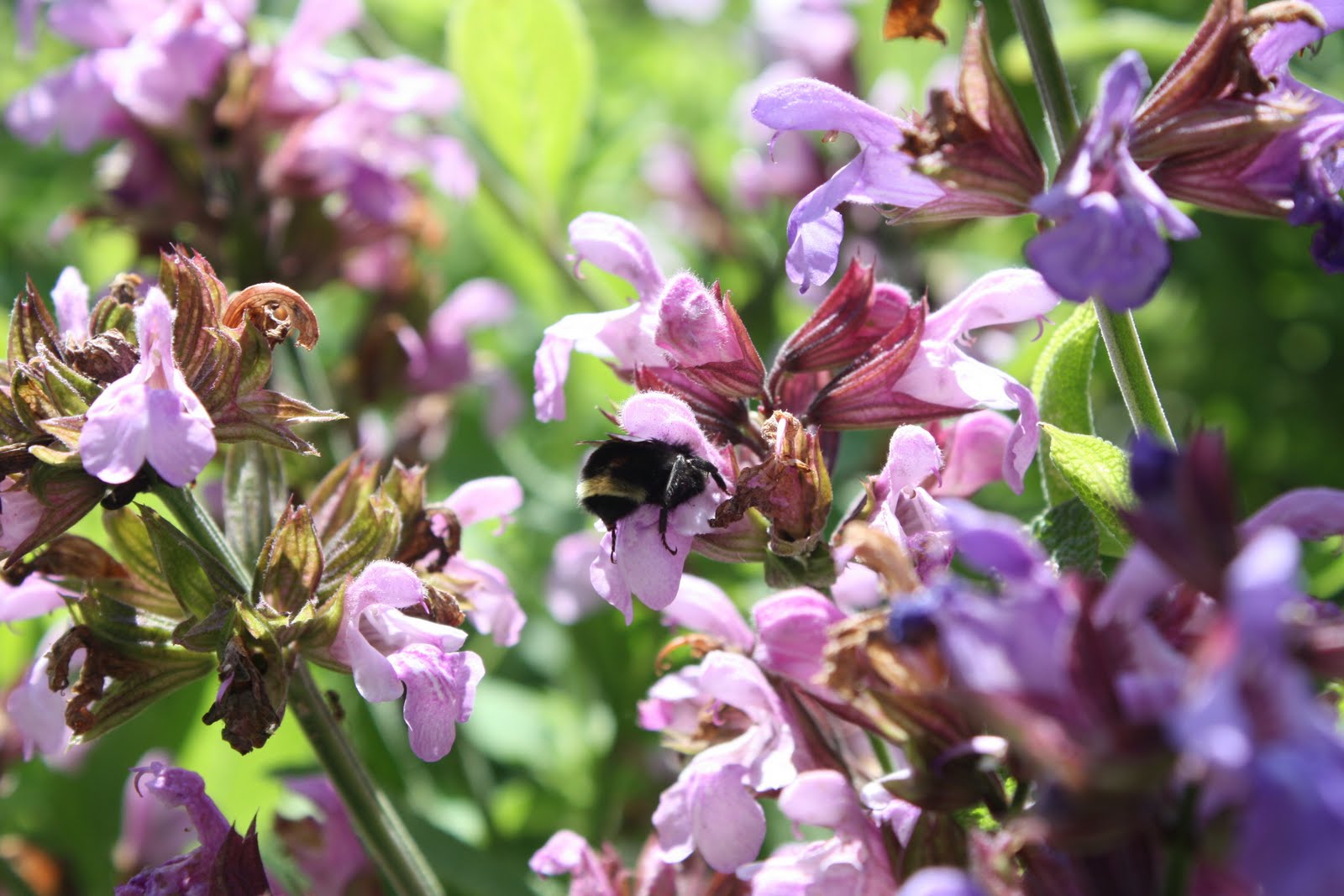
I'm not the only one who enjoys the purple flowers erupting all over the sage, thyme, and lavender. The bumblebees buzz back and worth all day, wriggling their little bottoms in sheer nectar ecstasy.

Chronicles of Noodlemaking, Week 9: More gnocchi

It's not very adventuresome I know, but those first gnocchi were so tasty that I couldn't resist returning to them. There was a large quantity of spinach just starting to go, and my first thought was malfatti which I have yet to try making, but since we had no ricotta and we did have potatoes, regular potato-spinach gnocchi it was.

The method was pretty much the same as the plain potato; you just chop up the washed spinach and mix it into the potatoes around when you mash them. It did make the dough rather moister, so it was a bit trickier to work with, and the end texture a little less perfect, but it was still fun and tasty.

To eat them, I panfried a portion up with nothing more than a little butter, a lot of sage, and a healthy chunk of sheep feta. And it was DIVINE.

Somehow no one else was around and eating, so I worked my way through the whole batch, admittedly getting a little less enthused as the week wore on. But they were also good with salmon and roasted onion and fennel, with herbs and tomato, and just blandly microwaved with parmesan and pepper overtop on a particularly tired day. Mmmm gnocchi.

First Harvest

In a slight mystery, the swiss chard that I whimsically planted in a small pot between two chile plants is growing by exuberant leaps, while the plants that have lots of room to spread out in the earth are peaked and piny. Is there anything better for the homecook than to walk into the kitchen bearing the fruits (and leaves) of things she's planted with her own hands?

Springtime in purple and green

It may officially be summer, but with all the cold grey weather we've been having, the garden is just starting to wake up. Suddenly the herb garden is awash in purple flowers, and seeing those little buds of lavender makes it easy to hope that we'll have warmth again here, soon, too.

Chronicles of Noodlemaking, Week 8: Spätzle

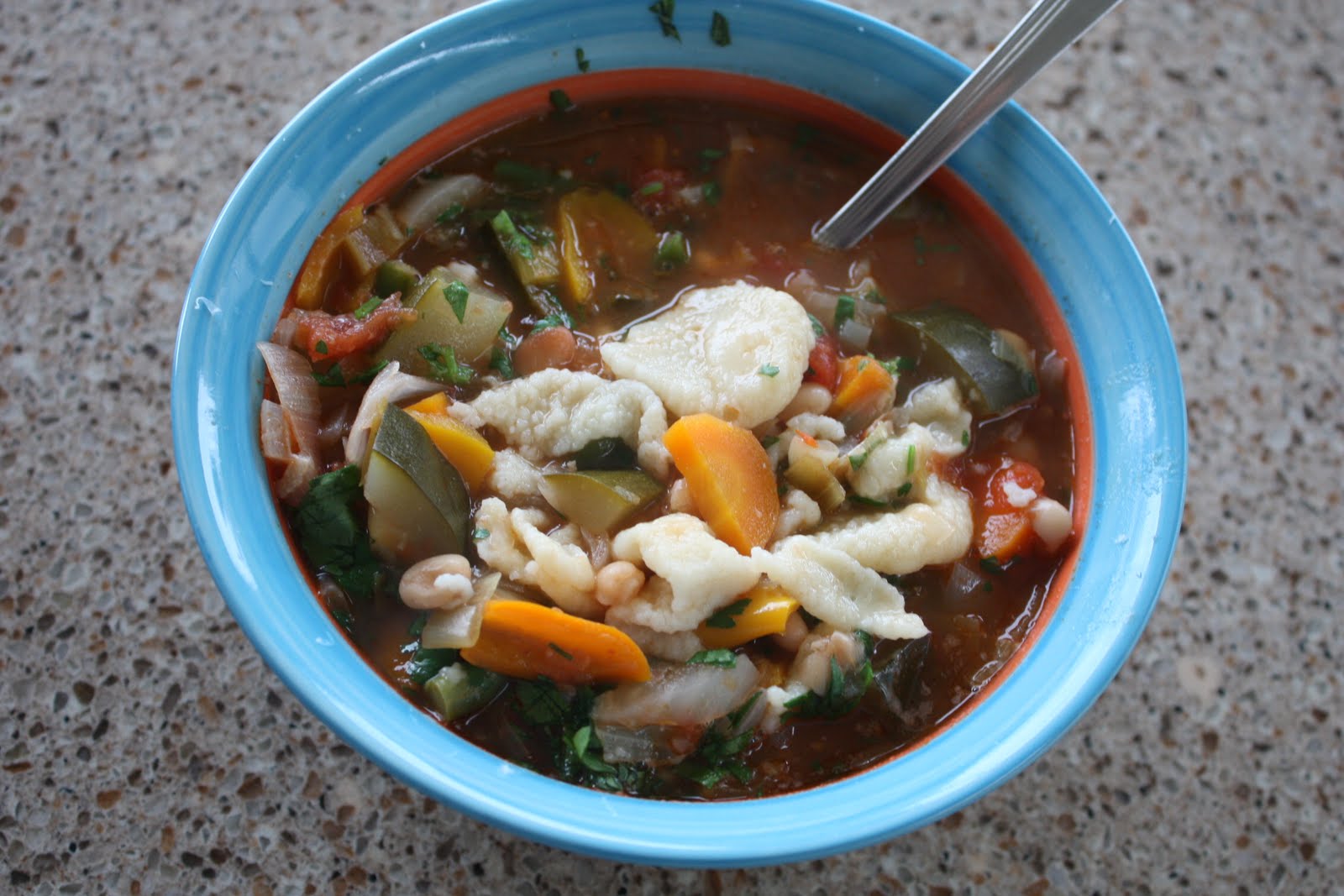
It's not that I thought making spätzle would be particularly hard, but I couldn't really believe how little time it took - 20 minutes after I had started whisking the batter together, I was sieving the last little dumplings from their boiling pot. Perfect spätzle doubtless take a lifetime, but I'm here to tell you that delicious, light, chewy egg noodles can be yours in less than half an hour.

I felt like doing something a bit different, and now that my sister's Joy of Cooking has moved back into this house, knew that there would be at least one spätzle recipe there. For a basic spätzle, you stir together flour, baking powder, salt, and nutmeg, then beat in milk and eggs to make a liquidy batter (Joy describes it as "elastic"). Boil a big pot of water or stock, drop little squiggles into the water a few at a time, and rescue them when they float to the surface (which happens quite quickly). Finito! Much easier than pie.

Now for the notes. Making the batter was of course easy, the only difficulty in knowing what the consistency should be. Joy says to taste the first few to make sure they are light and delicate rather than heavy and dense - adding more water or milk is supposed to lighten them. Mine always were quite light but I did end up adding quite a bit more milk (there was the end of a bottle going bad). I used skim for that reason, sort of a compromise between milk and water though usually I'd prefer to cook with 3.25%.

The only real difficulty was shaping the spätzle. It didn't really matter that they were uneven in size, since it's easy to strain each out as it is cooked. It's just that by dropping them from a spoon I ended up with rather distressingly spermatozoidal noodles. I was recounting this to a friend later and she pointed out that I could just push the batter through a slotted spoon - next time!

As for eating - well, they were delicious. We have whole nutmegs in the spice drawer, and grating even that small amount in made a huge difference in flavour - it subtly permeated the mouth without being in any way cloying. My mother and I kept snacking on them plain from their platter, but we also ate them in minestrone and they went beautifully there. It is important to not pile them on each other after you fish them out - they don't stick to each other, but they do keep steaming and get a bit soggy that way.

So if you visit this blog hoping for a weeknight noodle, this is the clear winner so far - quick, easy, forgiving and pairing well with lots of dishes. There were quite a few other dumpling recipes in Joy, so I'll have expand my horizons. I don't think I've even tasted U.S. Southern-style cornmeal dumplings - unless they're akin to those amazing dumplings at Jamaican restaurants in Brooklyn? Ah, The Islands, how I miss you and and your okra 'n codfish, and your charming staff that make one not mind that one has to wait two hours for supper.

Thursday, June 10, 2010

Bandits

Who was that masked cake-eater? (No, I don't mean the emu.)

Peonies


The Cake!

And here is the cake in its full glory. First a closeup on the "experimental" placing of a square on top of a circle (two circles = three layers total), and my "hipster messy hair" approach to spreading the buttercream.


Then a cross-section:


Here you can see the layers - white cake brushed with lavender syrup, layered with lemon-chocolate ganache and lemon curd, and topped with lemon buttercream and lavender meringues. The lavender flavour didn't come through that well, but the cake is pretty tasty - even now, a week and a half later.

Monday, June 07, 2010

Chronicles of Noodlemaking, Week 7: Failure!!!

It had to happen sometime. And actually, as failures go, this was fairly unsuccessful, in that it wasn't all that bad. For one thing, I made the failed noodles the same day that I pulled a 16-hour kitchen marathon, so that I was too tired to care whether they tasted good or not, I was just happy to stop making food. And for another reason, they didn't qualify as a kitchen disaster. Disasters, like my attempts to make dosas and injera, have to make a horrible mess that takes hours to clean up, or at least ruins some piece of kitchen equipment. Or at a minimum, they have to use up ingredients too costly to replace. All that happened here was, I made the noodles, and they didn't taste good. Moving on!

The noodle in question was the Hand-Rolled Rice Noodle, and I actually really enjoyed making them. I kneaded together the dough of rice flour, salt and water, before starting the cake layers for my mother's fancy birthday cake. The blob of dough sat resting while I worked my pastry wiles, then I did the shaping and cooking all in the time that the egg whites and sugar syrup for the buttercream were being combined and cooled in the stand mixer. So, another quick and easy recipe.

They were fun to shape, too. With slightly oiled hands, I pinched off pieces of dough, rolled them between my hands into a ball, and then into a tapered cylinder, fat at the centre in the space between my palms and thinner, pointed at the edges. This technique also felt pleasantly intuitive, except that despite repeatedly re-oiling my hands, the dough kept unpleasantly sticking, and didn't seem to be of the right texture. Sure enough, when it came to the boil, I just couldn't cook them to a pleasant texture. It's possible I missed the crucial window, but I think they segued gracelessly from undercooked to overcooked and mushy, with nothing of the spring and bite you'd expect from a rice noodle.

I had made a quick salsa to go with them, Market Stall Fresh Tomato Salsa also from Beyond the Great Wall, which was flavoured with sesame oil and chives and was really delicious. So I mixed my mushy sad little blobs of noodle with the salsa in a bowl and tried to eat them. The flavour wasn't bad, but I had this unpleasant insecurity about whether or not I was eating raw rice somehow, so I eventually gave up. After sampling syrup, curd, ganache, cake batter, buttercream, and meringues all day, it's not like there was much room left for real food anyway.

I have two theories about the failure. One is that right from the get-go I knew the dough was too wet. The instructions explain that it will be stiff and hard to work and mine wasn't - maybe I put too much water in, and if I'd kneaded in more flour as I thought of doing initially, it might all have been ok. The other problem is that I was using schmancy organic brown rice flour from the US rather than standard white rice flour. The former was probably long or medium grain instead of a stickier shorter grain Asian rice, so maybe it was just not great for the recipe. I've now acquired some plain rice flour and I'll be sure to try again...

Cake experiment

I can't believe how much I cooked last Saturday. The most complicated thing was inventing a new cake for my mother's birthday. It's shown here in an intermediate stage on Saturday night, about 14 hours after I started cooking that morning.

So far, it's a basic white cake from Joy of Cooking, brushed with a lavender syrup I made from the herbs in our garden. The cake layers are brushed with lemon-chocolate ganache and lemon curd, about to be popped into the fridge to let them set a bit before receiving their final coating of lemon buttercream.

The innovation (besides putting a square cake layer on top of two round ones, a decorating choice that was more original than successful but ah well) was mostly in the lavender syrup, since otherwise I just modified existing recipes (replacing orange with lemon). Unfortunately the lavender flavour didn't come through enough. Even though I felt like I'd saturated the cake layers thoroughly, there was room for more moisture there and that would have helped - plus it's too early and cold for there to be lavender blossoms so I just had to use the leaves which yielded a less intense flavour. What I really needed to do was make a lavender buttercream, but after all those hours in the kitchen (and with 3lbs of butter at stake) I wasn't prepared to do it without a recipe...next time.